Information Integrity in BIM: Are We Checking Too Late?
As AI becomes increasingly integrated into BIM workflows, the ability to identify inconsistencies and validate information is evolving. But are we checking information quality early enough? This article explores the importance of information integrity, proactive validation and the risks of relying on late-stage reviews.
Why preventing information errors during production matters more than simply detecting them faster.
The growing use of AI in BIM presents opportunities to automate model reviews, identify inconsistencies and assess information quality at a scale that would be difficult to achieve manually.
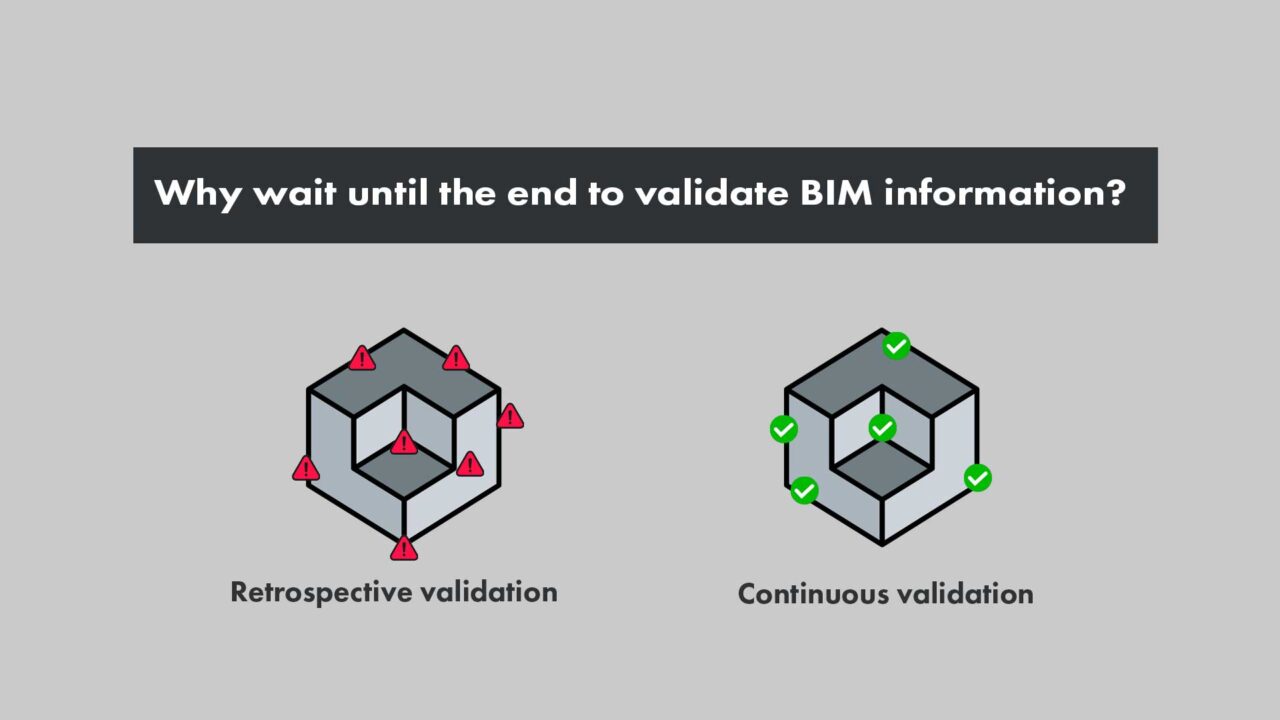
But there is a fundamental question worth considering: Why wait until information has been produced before checking whether it is correct?
The limitations of retrospective checking
Traditional BIM quality assurance typically relies on scheduled model audits, coordination reviews and pre-issue checks.
AI could make these processes considerably more efficient. It can help identify anomalies, interrogate large datasets and highlight inconsistencies across models and supporting documentation.
However, identifying an issue does not eliminate the work required to resolve it.
Consider a model containing hundreds of elements with incorrect classifications, missing required parameters or improper workset assignments in Revit. An automated review might identify these problems in minutes, but correcting them could still require significant effort, particularly when the information has already been used in schedules, documentation or coordination activities.
The problem is not necessarily the speed of checking. It is when the checking takes place.
Moving quality assurance into production
What if information requirements were continuously assessed as a model develops?
Rather than waiting for a formal audit, defined rules could validate elements as they are created or modified.
Incorrect workset assignments could be corrected automatically. Missing parameters could be flagged immediately. Naming conventions, classification requirements and other objective information standards could be monitored throughout production.
This changes the role of quality assurance from identifying accumulated problems to preventing them from becoming embedded in the information model.
When supported by appropriate audit logging, continuous validation can also record identified issues, corrective actions and their resolution, providing a traceable history of information quality throughout model development.
Importantly, continuous validation should not mean constantly interrupting designers. Effective systems need to distinguish between issues that can be safely corrected, those requiring user attention and those best addressed during scheduled reviews.
Where does AI fit?
AI remains valuable, particularly where requirements are complex, contextual or difficult to express through fixed rules.
For example, AI-assisted reviews could help compare model information against specifications, identify unusual patterns, assess potential inconsistencies across disciplines and prioritise issues for human investigation.
But for deterministic requirements, such as whether an element has a mandatory parameter or belongs to the correct workset, conventional rule-based validation may be more predictable and easier to audit.
The distinction is important. Not every information quality problem requires AI, and not every problem can be resolved through predefined rules.
A more effective approach

I believe reliable information delivery requires three complementary levels of assurance.
Continuous validation during production to address objective compliance requirements as information is created or modified.
Periodic coordination and quality reviews to assess relationships between models, design interfaces and developing project requirements.
AI-assisted and formal milestone assurance to interrogate broader information quality, identify less obvious inconsistencies and confirm readiness for exchange.
These approaches should reinforce one another rather than compete.
Ultimately, information integrity is not simply about delivering a model that passes its final checks. It is about maintaining the reliability, consistency and traceability of information throughout its development.
The next significant improvement in BIM quality assurance may not come from finding errors faster, but from allowing fewer errors to accumulate in the first place.
Ultimately, the line will likely be risk-based, what is safe to auto-correct versus what requires a human eye. Where should we draw the line between automated correction, continuous monitoring and human review? I’d love to hear your thoughts.
Continue the conversation on Discord
Our Discord is where the wider conversation happens: career advice, CV reviews and roles shared as they come up.
Comments
Questions and comments from abcBIM.com members. New comments appear once a moderator has approved them.